Views: 0 Author: Site Editor Publish Time: 2026-05-18 Origin: Site
The 2026 PET sheet manufacturing industry is expanding rapidly, driving strong demand for high-efficiency Sheet/Plate Extrusion Machines and intelligent PET sheet production lines. As packaging, thermoforming, medical, and industrial applications continue to grow, manufacturers are increasingly upgrading extrusion equipment to improve product quality, automation, and production efficiency.
Modern PET sheet manufacturers must balance transparency, thickness precision, thermoforming performance, recycled material compatibility, and energy efficiency while reducing operational costs and maintaining stable production.
This guide explores PET sheet manufacturing processes, extrusion line configurations, common production challenges, and PET sheet extrusion machine solutions to help manufacturers improve productivity and long-term competitiveness.
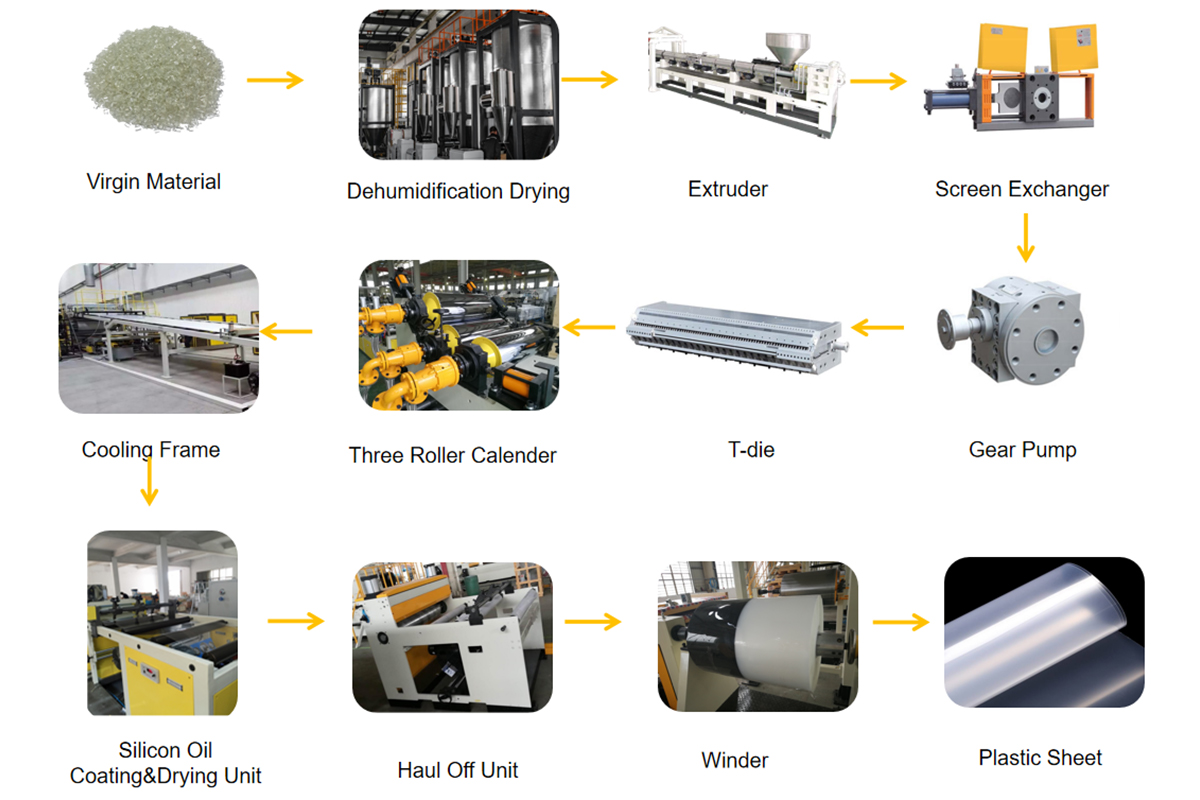
PET sheet is typically manufactured through a continuous extrusion process using professional PET sheet extrusion machines. The production process includes raw material drying, melt extrusion, filtration, T-die forming, calender cooling, trimming, and automatic winding.
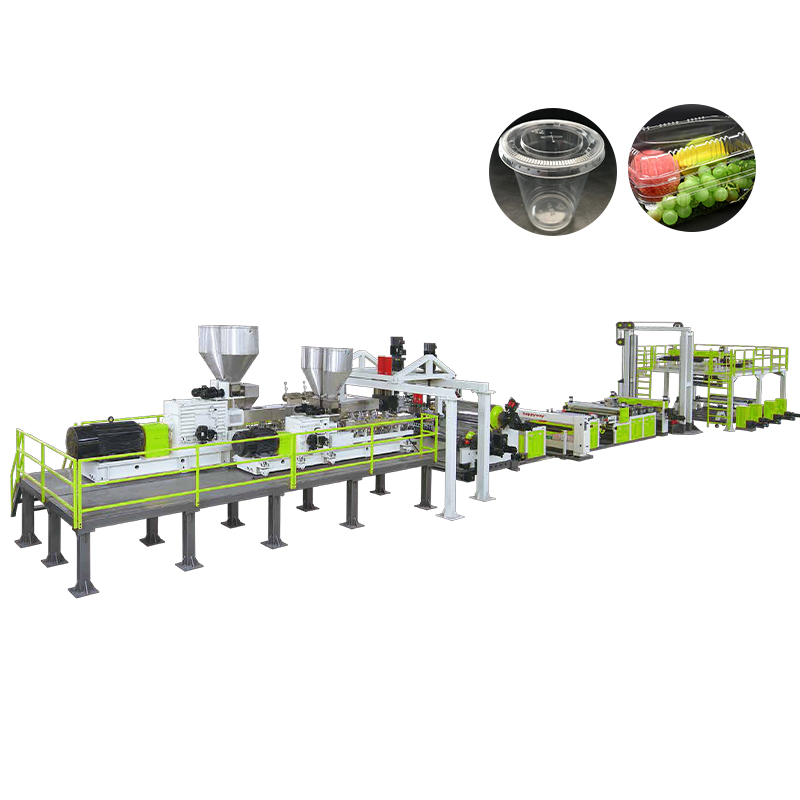
A complete PET sheet extrusion line generally includes:
Crystallizing drying system
Twin screw extruder
Hydraulic screen changer
Melt pump
T-die system
Three-roller calender
Cooling and traction system
Automatic winding machine
Advanced Sheet/Plate Extrusion Machines help manufacturers achieve stable thickness control, high transparency, and efficient continuous production.
Modern packaging requires materials that guarantee product safety while ensuring environmental compliance. We are seeing a rapid shift away from older polymers toward advanced polyesters. You need to understand exactly why legacy plastics are losing their market dominance.
For decades, Polyvinyl Chloride (PVC) dominated the blister packaging industry due to its low initial price and easy thermoforming capabilities. However, its chemical composition poses severe compliance risks today. PVC requires chemical plasticizers to achieve flexibility, and these additives can leach into packaged goods. Furthermore, incinerating PVC releases highly carcinogenic dioxins and hydrogen chloride gas. In contrast, Polyethylene Terephthalate features a plasticizer-free, food-safe composition. It boasts full FDA compliance for direct food contact and supports true closed-loop recyclability. Regulatory bodies are penalizing PVC usage, making the transition mandatory rather than optional.
When evaluating mechanical toughness, Polystyrene often falls short. PS is inherently brittle under impact. If you use it for transit packaging, you will likely experience high rates of cracking and breakage during shipping. Polyethylene Terephthalate offers a far superior alternative. It combines high optical clarity with exceptional tensile strength. This structural resilience drastically reduces transit damage, keeping your products secure from the factory floor to the retail shelf.
Polypropylene (PP) remains a popular choice due to its light weight and flexibility. Yet, it fails when you require extended shelf life for sensitive products. PP lacks sufficient gas and moisture barrier properties. Polyethylene Terephthalate excels in this area, offering a dense molecular structure that blocks oxygen and moisture ingress. If you package fresh foods, medical instruments, or sensitive electronics, this superior barrier performance is absolutely mandatory to prevent spoilage and degradation.
Material | Mechanical Toughness | Barrier Performance | Environmental/Compliance Status |
|---|---|---|---|
PVC | Moderate, requires plasticizers | Good moisture barrier | High risk (Dioxins, phasing out) |
PS (Polystyrene) | Brittle under impact | Poor gas barrier | Difficult to recycle economically |
PP (Polypropylene) | Flexible, good hinge property | Weak oxygen barrier | Recyclable, FDA compliant |
PET | High tensile strength, impact resistant | Excellent gas & moisture barrier | 100% Recyclable, FDA compliant |
Sourcing raw materials requires strict adherence to technical specifications. If you accept broad tolerances, your thermoforming lines will suffer from inconsistent yields. You must evaluate suppliers based on precise, measurable dimensions.
Intrinsic Viscosity measures the polymer's molecular weight and structural integrity. For standard sheet extrusion, you must demand an IV strictly between 0.80 and 0.88 dL/g. This range is non-negotiable. If the IV drops below this threshold, the material becomes brittle during heating. If your application involves deep-draw thermoforming, you need slower-crystallizing polymer structures. Typically, manufacturers achieve this by utilizing "water-bottle-grade" resins that maintain strength even when stretched deeply into complex mold cavities.
Polyethylene Terephthalate demonstrates incredible dimensional stability, particularly in challenging environments. It features an ultra-low water absorption rate of just 0.07% and a solid density of approximately 1.39 g/cm³. When you compare it to nylons or acetals, which swell and warp in humid conditions, this material remains perfectly stable. You can rely on it for high-precision packaging where warping would ruin the seal integrity.
Uneven thickness ruins production runs. When a sheet enters a thermoforming machine, thin spots cause webbing, while thick spots lead to incomplete forming. You must establish strict industrial benchmarks for gauge control. Sheets ranging from 0.12mm to 1.6mm should consistently maintain a strict +/- 1% thickness tolerance. High-end suppliers achieve this precision using closed-loop extrusion control systems integrated directly into their calendaring lines.
You must establish clear operational boundaries for your packaging. Standard Amorphous PET (A-PET) begins to deform and soften at temperatures above 100°C (210°F). Therefore, you cannot use standard A-PET for hot-fill packaging or high-temperature steam sterilization applications. Understanding these thermal limits prevents catastrophic failures during secondary processing or consumer use.
Specification Summary Chart | ||
Parameter | Acceptable Industrial Range | Impact on Production |
|---|---|---|
Intrinsic Viscosity (IV) | 0.80 – 0.88 dL/g | Dictates tensile strength and deep-draw capability. |
Water Absorption | ≤ 0.07% | Ensures dimensional stability in high humidity. |
Thickness Tolerance | +/- 1% | Prevents thermoforming webbing and material blowout. |
Deformation Temp. | 100°C (210°F) | Sets limits for hot-fill and sterilization viability. |
PET sheet production requires stable melt pressure, accurate temperature control, and precise calender adjustment. Poor extrusion control may cause:
Uneven sheet thickness
Surface defects
Crystal points
Poor thermoforming performance
Reduced transparency
Modern PET sheet extrusion lines are equipped with:
Automatic thickness control systems
Intelligent PLC control
Precision temperature systems
Multi-layer co-extrusion technology
These advanced technologies help manufacturers improve product consistency and reduce production waste.
Suitable for standard thermoforming and packaging sheet production.
Designed for high-barrier and functional sheet applications.
Ideal for disposable food trays, cups, and containers.
Used for high-transparency industrial and printing sheet production.
Supports RPET processing with advanced filtration and degassing systems.
As global demand for PET sheet continues to grow, manufacturers increasingly require intelligent, stable, and energy-efficient PET sheet extrusion solutions.
Modern Sheet/Plate Extrusion Machines help manufacturers improve transparency control, production efficiency, automation levels, and final product consistency while reducing operational costs.
Whether producing APET, PETG, CPET, or recycled PET sheet products, choosing the right PET sheet extrusion machine is essential for long-term manufacturing success and market competitiveness.
A: The primary difference lies in crystallization. Standard A-PET crystallizes and turns cloudy if overheated during deep-draw thermoforming. PETG (Glycol-Modified PET) prevents this crystallization. It remains perfectly clear under heat and offers superior impact resistance, making it much easier to thermoform for complex, high-stress applications.
A: Yes, it is 100% recyclable. Through advanced depolymerization (chemical recycling), it can be infinitely broken down and rebuilt without losing strength. Alternatively, mechanical recycling allows it to be continuously reused in products like micro-foamed boards, supporting a fully closed-loop circular economy.
A: It has an ultra-low moisture absorption rate of just 0.07%. Nylon, by contrast, absorbs significant moisture from the air, causing it to swell and change dimensions. This low absorption makes polyester highly dimensionally stable, ensuring precise fits in humid or wet operational environments.
A: When processed correctly, it does not impact clarity. Advanced melt-filtration and modern chemical recycling techniques remove microscopic impurities. This keeps high-quality RPET visually indistinguishable from virgin resin, maintaining an impressive 90% to 92% light transmission rate for premium retail packaging.