Views: 0 Author: Site Editor Publish Time: 2026-08-13 Origin: Site
Table of Contents
PPR pipe has become a widely used solution for modern plumbing, heating, and water distribution because of its corrosion resistance, thermal stability, and reliable heat-fusion connections. However, pipe performance depends not only on the polypropylene random copolymer material itself, but also on pipe structure, pressure rating, manufacturing accuracy, and extrusion technology. This guide explains the main types, applications, production process, and installation of PPR pipe, while also introducing how Bekwell PPR pipe extrusion equipment supports stable forming, precise sizing, efficient cooling, and continuous production for pipe manufacturers.
PPR pipe is made from polypropylene random copolymer, a thermoplastic known for corrosion resistance, thermal stability, and long service life. Its smooth inner wall reduces scaling and pressure loss, while heat fusion creates strong joints. PPR is widely used in hot and cold water, heating, plumbing, and industrial water systems.
Common types include standard PPR, glass-fiber-reinforced PPR, aluminum-layer PPR, PPR-CT, flame-retardant PPR, and oxygen-barrier PPR. Reinforced types are used where lower thermal expansion or higher rigidity is needed.
Typical pressure ratings include PN10, PN16, PN20, and PN25. Lower SDR values generally mean thicker walls and higher pressure capability. Relevant standards include ISO 15874, DIN 8077/8078, and regional potable-water requirements.
PPR pipes are used in residential water supply, heating, industrial systems, irrigation, and municipal distribution. Selection should match temperature, pressure, diameter, and installation conditions.
Production starts by feeding PPR resin into an extruder, where it is heated and plasticized. The melt passes through a pipe die to form the required diameter and wall thickness. The pipe then enters vacuum calibration and cooling, followed by haul-off and cutting.
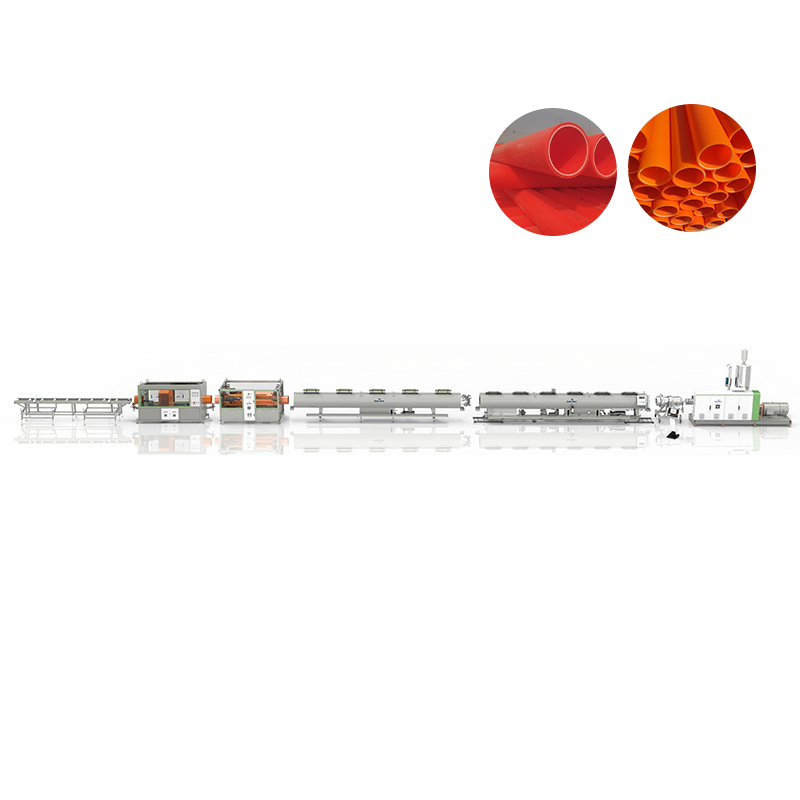
A typical line includes feeding, a single-screw extruder, die head, vacuum calibration tank, cooling tank, haul-off unit, cutter, and PLC/HMI control.
Bekwell provides integrated extrusion solutions for PP-R, PE-RT, PB, HDPE, PVC, and other thermoplastic pipe materials. Its PPR pipe extrusion equipment can be configured according to pipe size, target output, production speed, and automation requirements.
Key features include:
Integrated Production Process: Combines raw material feeding, extrusion, die forming, vacuum calibration, cooling, haul-off, cutting, and automatic control in one continuous production line.
Stable Material Plasticization: The extruder provides consistent melting and homogenization of PPR material, helping maintain stable output during continuous operation.
Accurate Pipe Forming: The die and calibration system help control pipe diameter, wall thickness, roundness, and dimensional consistency.
Efficient Cooling and Sizing: Vacuum calibration and cooling sections stabilize the pipe shape quickly and support smooth downstream processing.
Synchronized Haul-Off Control: Controlled haul-off speed works together with extrusion output and cooling capacity to reduce dimensional variation.
Flexible Line Configuration: Equipment can be customized according to pipe diameter range, output requirements, cooling capacity, and automation level.
Automated Production Control: PLC/HMI control helps operators monitor production parameters and improve process consistency.
Improved Production Efficiency: A properly matched extrusion line can help reduce material waste, improve finished pipe quality, and support stable long-term production.
When selecting a PPR pipe extrusion line, manufacturers should consider extrusion stability, pipe size range, output, cooling efficiency, energy consumption, automation level, and downstream processing requirements rather than focusing only on maximum production speed.
PPR pipes are generally joined by heat fusion. Correct heating time, clean surfaces, square cutting, and sufficient cooling are essential for reliable joints.
PPR pipe offers durability, corrosion resistance, thermal performance and fusion joining. For manufacturers expanding PPR pipe production, Bekwell offers integrated extrusion equipment from feeding to finished pipe handling.
PPR pipe is made from polypropylene random copolymer, a thermoplastic material known for corrosion resistance, thermal stability, impact resistance, and suitability for hot and cold water systems.
A PPR pipe extrusion line is a continuous production system used to manufacture PPR pipes from raw polypropylene material. It typically includes feeding, extrusion, die forming, vacuum calibration, cooling, haul-off, cutting, and automatic control equipment.
Typical equipment includes a material feeding system, single-screw extruder, pipe die head, vacuum calibration tank, cooling tank, haul-off unit, cutting machine, and PLC/HMI control system. Bekwell can provide integrated configurations according to production requirements.
Key factors include required pipe diameter, wall thickness, production output, cooling capacity, automation level, energy consumption, and the types of PPR pipes you plan to manufacture.
Yes. Depending on the equipment configuration and tooling, a PPR pipe extrusion line can support different pipe diameters and specifications. Dies, calibration components, and operating parameters may need to be changed for different products.
Bekwell integrates extrusion, forming, calibration, cooling, haul-off, cutting, and automatic control into a complete production line. Proper coordination between these sections can help improve dimensional consistency, production stability, and overall manufacturing efficiency.