Views: 0 Author: Site Editor Publish Time: 2026-05-18 Origin: Site
The 2026 PET film manufacturing industry is growing rapidly, driving strong demand for advanced Sheet/Plate/Film Extrusion Machines and high-efficiency PET film production lines. As global shrink film markets continue expanding, manufacturers are increasingly upgrading extrusion equipment to improve product quality, automation, and production efficiency.
Today’s PET film manufacturers must balance thickness precision, transparency, barrier performance, energy consumption, and recycled material compatibility while managing global supply chain and cost pressures.
This guide explores PET film manufacturing processes, extrusion line configurations, production challenges, and PET sheet/film extrusion machine solutions to help manufacturers improve efficiency, reduce costs, and enhance product competitiveness.
PET film, also known as Polyethylene Terephthalate film, is a high-performance thermoplastic material widely used in packaging, thermoforming, printing, electronics, medical products, and industrial applications. PET film offers excellent transparency, mechanical strength, dimensional stability, and chemical resistance.
Modern PET film products are typically manufactured through precision extrusion technology using professional PET sheet and film extrusion machines.
PET film is produced through a continuous extrusion process that includes:
PET resin drying
Melt extrusion
Filtration and melt metering
T-die sheet forming
Three-roller calendering
Cooling and trimming
Automatic winding
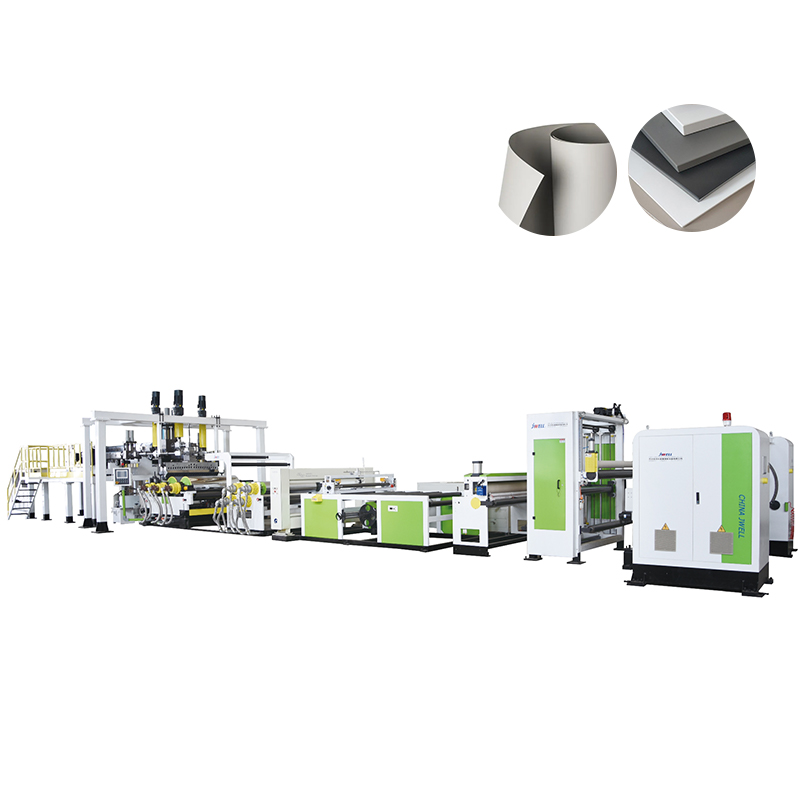
A complete PET film extrusion line generally includes:
Dehumidifying drying system
Twin screw extruder
Hydraulic screen changer
Melt pump
T-die system
Three-roller calender
Cooling frame
Automatic winding machine
High-performance Sheet/Plate/Film Extrusion Machines help manufacturers achieve stable thickness control, excellent transparency, and high production efficiency.
When you engineer flexible packaging or industrial laminates, performance begins with base material properties. PET film stands out due to its unique molecular structure. The stretching process aligns polymer chains to create exceptional physical characteristics.
Thermal endurance dictates where a material can safely operate. Standard biaxially oriented polyester operates safely between -40°C and 150°C. It boasts a high melting point of approximately 250°C. This extreme thermal stability is crucial for high-speed converting. The substrate strongly resists thermal shrinkage when it passes through hot printing ovens or lamination rollers. You avoid web distortion, which reduces misregistration in your printing lines.
High web strength directly prevents machine downtime. During the BOPET manufacturing process, extruders stretch the material in both machine and transverse directions. Typical stretch ratios range from 3:1 to 4:1. This biaxial orientation unlocks an impressive tensile strength of 200–250 MPa. You gain excellent structural rigidity. This allows you to down-gauge your material thickness without sacrificing performance on automated packaging lines.
Engineers often miscalculate yield by using incorrect density values. You must differentiate base amorphous polymer density from its crystalline counterpart. Standard amorphous polyester has a density of roughly 1.33 g/cm³. However, crystalline BOPET density increases to 1.38–1.40 g/cm³ due to the stretching process.
Clear Films: Typically calculate at 1.39 g/cm³.
Matte/White Films: Additives like titanium dioxide (TiO2) increase density.
High-Fill Films: Density can reach 1.45+ g/cm³.
This density variation directly impacts your roll weight and freight costs. Heavier rolls yield less length per kilogram. You must use the exact density for your specific grade to avoid procurement shortfalls.
Protecting sensitive products requires robust barriers. This substrate provides an optimal balance for moisture vapor transmission rates (MVTR) and oxygen transmission rates (OTR). It creates a highly secure environment against atmospheric degradation. Additionally, it remains highly resistant to oils, greases, and industrial solvents. This makes it an ideal candidate for aggressive chemical environments.
Selecting the right polymer requires a clear understanding of trade-offs. The chart below provides a quick reference for engineers comparing PET film against common alternatives.
Material | Max Operating Temp | Oxygen Barrier | Tensile Strength | Primary Limitation |
|---|---|---|---|---|
PET (BOPET) | 150°C | Excellent | 200–250 MPa | Higher baseline cost |
Polyethylene (PE) | 80°C | Poor | 15–30 MPa | Fails under high heat |
Polypropylene (BOPP) | 130°C | Moderate | 130–150 MPa | Lower temperature resistance |
PVC | 65°C | Moderate | 40–60 MPa | Plasticizer leaching risks |
PE generally offers lower costs and excellent moisture barriers. It acts as a superb sealing layer. However, PE fails rapidly under high heat. It also lacks the necessary oxygen resistance to protect perishable foods. When you need high-temperature stability and comprehensive barriers, polyester easily wins the head-to-head matchup.
BOPP dominates standard clear packaging and label markets because it is highly cost-effective. Yet, BOPP has limits. Polyester offers superior structural rigidity. It also delivers better printability and higher temperature resistance. You should specify polyester for demanding industrial laminations and high-end food applications where BOPP would melt or stretch.
PVC was historically popular for blister packaging and shrink sleeves. However, modern medical and food grades demand stricter chemical safety. PET film eliminates plasticizer leaching risks entirely. It offers a more compliant, chemically stable alternative. This helps you meet rigorous FDA and EU food contact regulations effortlessly.
Traditional high-barrier packaging relies on aluminum foil. Unfortunately, foil is heavy, expensive, and prone to flex-cracking. Vacuum-metallized polyester achieves near-foil barrier properties at a fraction of the weight. You reduce your shipping mass drastically. You also eliminate flex-cracking vulnerabilities, ensuring your package remains sealed throughout its transit lifecycle.
Different PET film applications require different extrusion technologies and equipment configurations.
Application | Recommended Equipment Features |
|---|---|
Food Packaging Film | High cleanliness extrusion system |
Thermoforming Sheet | High-output PET sheet extrusion line |
Medical PET Film | Precision thickness and contamination control |
Optical PET Film | Multi-layer co-extrusion technology |
Industrial PET Sheet | Stable heavy-duty extrusion system |
Choosing the right PET film production line helps improve product quality, reduce material waste, and increase operational efficiency.
PET film production requires extremely stable extrusion conditions. Even minor fluctuations in melt temperature, pressure, or roller speed may lead to:
Thickness inconsistency
Crystal points
Surface defects
Reduced transparency
Poor thermoforming performance
Therefore, modern PET sheet and film extrusion machines are usually equipped with:
Automatic thickness control systems
High-efficiency filtration units
Precision temperature control systems
Multi-layer co-extrusion technology
Intelligent PLC automation systems
Advanced extrusion equipment helps manufacturers achieve better product consistency, lower energy consumption, and higher production efficiency.
Specifying industrial packaging substrates is a delicate balancing act. You must align precision engineering requirements—like density variables and thermal resistance—with strategic, risk-aware procurement practices. Yield calculations and trade compliance are no longer optional steps; they are fundamental to successful sourcing.
As you plan your next production cycle, take immediate action to secure your supply chain. Advise your technical buyers to initiate supplier conversations early. Request technical data sheets (TDS) for every proposed grade. Confirm that corona treatment dyne levels match your printing capabilities. Finally, always request verified proof of trade compliance before ordering your initial pilot test rolls.
A: Calculations usually fail because buyers use the wrong density. Standard amorphous polyester has a density of 1.33 g/cm³. However, biaxially oriented grades (BOPET) have a higher crystalline structure, pushing density to 1.38–1.40 g/cm³. Filled films containing titanium dioxide can exceed 1.45 g/cm³.
A: Yes, standard grades have naturally low surface energy. Inks and adhesives will not bond securely to untreated surfaces. You must ensure the material receives electrical (corona) or chemical treatments. This raises the surface energy to >42 dyne/cm for optimal printability.
A: No. Standard polyester has a high melting point of approximately 250°C and does not seal to itself under normal packaging conditions. To achieve a strong seal, you must specify a specialized co-extruded grade or apply a dedicated heat-seal layer.
A: Thicker gauges significantly improve structural rigidity and offer marginal barrier improvements. However, if your application demands exceptional high-barrier performance, increasing thickness is inefficient. You achieve better moisture and oxygen barriers through specialized PVdC coatings or vacuum metallization.